


THE HAPPY HIGHLANDER’S RECORDS Episode 4 - When the Bells Rang and the Flags Flew: VE Day 1945
You can watch the video episode here
(full of bonus images and slides with information in text form):
Or you can listen to the Audio Podcast here:
THE HAPPY HIGHLANDER’S RECORDS
Episode 4
When the Bells Rang and the Flags Flew: VE Day 1945

Fit like a’body. I hope you are all hale and hearty and most importantly, happy. So hello and welcome, friends, to The Happy Highlander’s Records — the programme where we wind back time, lower the needle, and let history speak for itself.
Today’s broadcast is another special one. We’re stepping back to the evening of May the 8th, 1945—a day remembered across Britain, across Europe, and across the world as Victory in Europe Day, or simply VE Day.
After nearly six long years of war, the news finally came that Nazi Germany had surrendered. Across Britain church bells rang, people danced in the streets, bonfires were lit, and neighbours who had endured the blackout, rationing, and air raids together finally celebrated together. But before the parties began, the nation listened. Radios across the country crackled into life as people gathered around them to hear the words that confirmed what many had hardly dared to hope for.
In this episode of The Happy Highlander’s Records, we’re going to hear history exactly as people might have heard it in 1945—through the grooves of original 78-rpm shellac gramophone records.
I’ve chosen three historic HMV records, spread across five sides, capturing the voices and sounds of VE Day itself.
First we’ll hear the speech that officially announced the victory to the nation from Britain’s wartime Prime Minister, Winston Churchill.
Then we will hear the broadcast message from His Majesty King George VI, beginning with the words “Today we give thanks.”
And finally, we’ll listen to the sound that rang out across Britain on that joyous day—the bells of some of the country’s great churches and cathedrals celebrating victory.
We will also have an extremely special guest, my mother Rona, who had her fifth birthday on 6th May 1945 and we will hear her memories of that time.
So wind up the gramophone, settle in comfortably, and let’s travel back to VE Day, 1945.
Our first record tonight contains one of the most famous announcements in British history. It’s a 10-inch HMV record featuring the voice of Britain’s wartime Prime Minister, Winston Churchill, announcing the end of the war in Europe. Churchill delivered this historic broadcast at 3pm on May 8th, 1945.

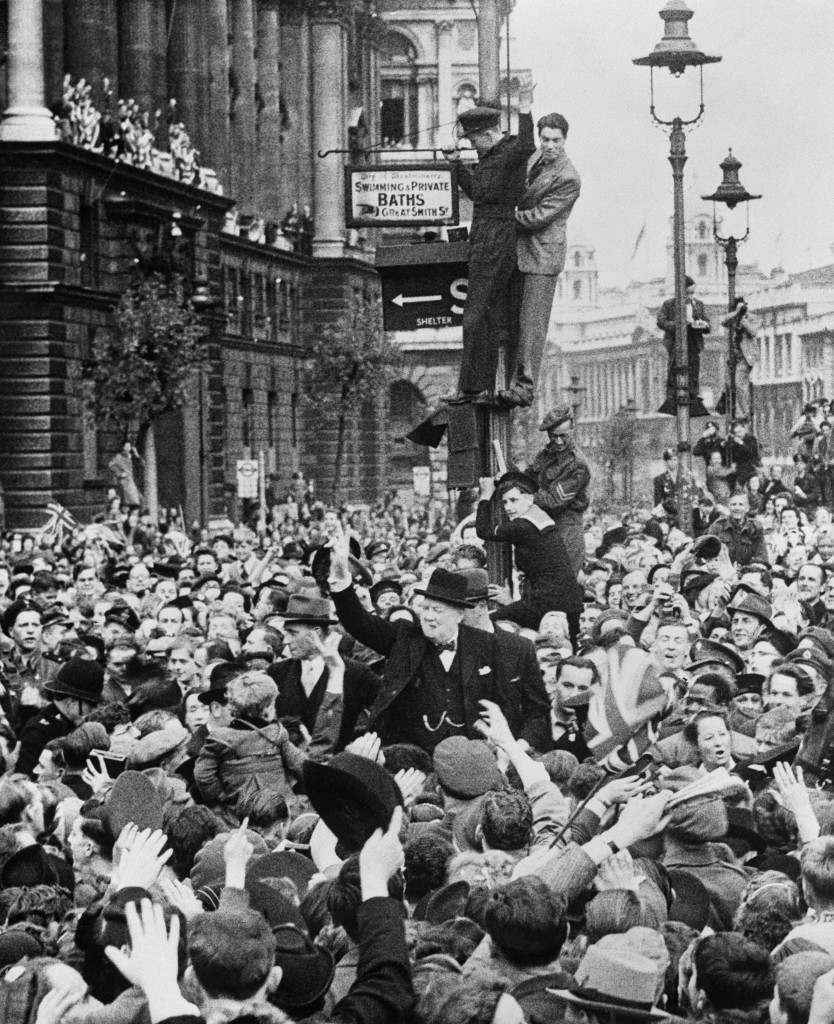
Millions of people across Britain were listening on the radio as he spoke the words everyone had been waiting to hear: “The German war is therefore at an end.” Within minutes of the announcement, celebrations began across the country. Crowds poured into the streets, especially in London where thousands gathered outside Buckingham Palace and in Trafalgar Square. Churchill himself later appeared on the balcony of the Ministry of Health building in Whitehall to greet cheering crowds before joining the King and Royal Family at Buckingham Palace. This little shellac disc preserves that moment.
Like many spoken recordings of the era, the speech is divided across two sides, so listeners would need to carefully turn the record over to hear the whole announcement. What I find fascinating about recordings like this is that they capture not just history, but atmosphere—the deliberate tone of Churchill’s voice and the sense that something truly momentous had just happened. So let’s return now to that afternoon in May 1945 and hear the voice that delivered the long-awaited news. Here is Winston Churchill, announcing “The End of the War in Europe.”
Our second record today is also a rather special one, from that very special day. It’s a 12-inch His Master’s Voice record, recorded and issued shortly after VE Day, containing the broadcast given by King George VI to mark the end of the war in Europe. The speech begins with the simple but powerful words: “Today we give thanks…”

Throughout the Second World War, the King and Queen had become powerful symbols of courage and unity for the British people. During the Blitz they famously refused to leave London, even after Buckingham Palace itself was bombed. By 1945, people across the country felt a deep personal connection to the King. When he spoke, people listened—not just as subjects, but as fellow citizens who had endured the war together.
This record captures that moment. It preserves the King’s calm, steady voice as he called on the nation to give thanks for victory, to remember those who had been lost, and to look toward rebuilding a peaceful world.
A small technical curiosity as well: because speeches like this were longer than the music normally recorded on 78s, they were often spread across two sides of a large 12-inch disc, which is exactly the case here.
So imagine the scene in 1945: families gathered around their wireless sets, church bells waiting to ring, and a nation finally able to breathe again. Here now is King George VI with his VE Day message: “Today We Give Thanks.”

There is an interview with my mother, Rona, whose fifth birthday was on 6th May 1945 – you can listen to her memories in the video or the podcast, and how, as a ew five year old, she thought all the bells and flags were to celebrate her birthday!
For our final record tonight we have something rather different—but just as evocative of VE Day. This HMV recording captures the bells of five great British churches and cathedrals, all rung in celebration on Victory Day, May 8th 1945. The record features the bells of: Westminster Abbey, York Minster, Coventry Cathedral, Bath Abbey and St Mary’s Church in Puddletown.


Across Britain, church bells held deep symbolic meaning during the war. In fact, from 1940 onwards they were largely silenced, reserved only to be rung as an invasion warning if German forces landed on British soil. So when the bells finally rang out freely again on VE Day, the sound meant far more than celebration—it meant peace had returned.
One especially moving inclusion here is Coventry Cathedral. The medieval cathedral had been devastated during the German bombing raid of November 1940, and its ruined shell became one of the most powerful symbols of the destruction of war and the hope for reconciliation.
The recording also features commentary by broadcaster Frank Phillips, helping listeners imagine the scenes around the country as bells pealed in thanksgiving.
For many people in 1945, these bells were the sound of relief after years of uncertainty. For nearly five long years of war, the bells of Britain had been mostly silent—kept ready only to warn of invasion. But on May the 8th, 1945, they rang freely once more. The bells rang out in celebration, thanksgiving, and relief. For many people who lived through the war, it was a sound they would never forget.
And through this old shellac record, we can hear those bells again today—just as they rang on Victory in Europe Day, 1945.
So to close today’s VE Day programme, let’s listen to those sounds of victory echoing across Britain. Here are the Bells of Victory Day, May 8th 1945.

Across the country—from great cathedrals to small parish kirks—the bells rang out in thanksgiving. They rang for victory. They rang for peace. And they rang in memory of those who did not return.
Slainte to those who did not come home and to those who did after the horrendous experience of war. We owe them all a huge debt .....
And with those bells ringing out and after the very special interview with a very special person, we come to the end of this special VE Day edition of The Happy Highlander’s Records.
Today we’ve heard the voices and sounds that marked one of the most important days of the twentieth century, preserved in the grooves of old shellac records and we have heard in person from my mum, who loved the celebrations for her fifth birthday in 1945!
This edition was recorded on an island off the West coast of Scotland where my collection of some 160,000 old shellac records is lovingly kept – to preserve, record and share these sounds from the past at 78rpm. You can listen to recordings of each individual record via my website TheHappyHighlandersRecords.com and also via my YouTube Channel Scottish Island Records. Until next time, keep the gramophone turning… and the memories spinning.
From The Happy Highlander’s Records, thank you for listening.
Comments