


THE HAPPY HIGHLANDER’S RECORDS Episode 13 - Songs of Glasgow Toon - Shellac from the Clyde
Updated: 4 days ago
You can watch the video episode here
(full of bonus images and slides with information in text form):
Or you can listen to the Audio Podcast here:
THE HAPPY HIGHLANDER’S RECORDS
Episode 13
Songs of Glasgow Toon - Shellac from the Clyde

Fit like a’body. I hope you are all hale and hearty and most importantly, happy.
So hello and welcome, friends, to The Happy Highlander’s Records - where old shellac spins once more and the past sings again through the horn of the gramophone.
Today’s broadcast takes us westward, to one of the great cities not only of Scotland, but of the world — the proud and passionate city of Glasgow.
Glasgow grew beside the River Clyde, a river that shaped its destiny. From a modest medieval religious settlement, it became during the nineteenth and early twentieth centuries the industrial heartbeat of Scotland.
Shipyards lined the banks, building vessels that sailed to every corner of the globe. Steel, engineering, trade, music halls, and working-class humour all mixed together to create a city with a character entirely its own.
But Glasgow is more than industry — it is voice. The voice of singers in tenements, choirs in grand halls, comedians on theatre stages, and ordinary people whose warmth and wit became legendary. Even during hard times, Glaswegians carried a reputation for humour, resilience, and generosity of spirit.
Today, we explore Glasgow through five sides of old records — shellac discs that once spun in living rooms, dance halls, and wireless broadcasts. Each carries a fragment of the city’s story: its river, its songs, its humour, and its unmistakable personality.
We will also will be chatting with a very special Glaswegian, my mum, about growing up in the dear green place in the 1940s, 50s and 60s.
So settle comfortably, imagine the gentle crackle of a well-loved 78, and let us begin our musical journey along the banks of the Clyde.
Our first record brings us directly to the river itself — the great silver thread running through Glasgow’s history — the Clyde.
Here we hear Song of the Clyde, sung by the wonderful Scottish tenor Kenneth McKellar, issued on the Decca label in 1958. McKellar possessed one of those voices that seemed made for Scottish song: clear, warm, and dignified, equally at home in folk music and classical repertoire.

Although recorded slightly later than the golden age of the 78rpm era, this performance carries the spirit of earlier Scottish ballad singing — romantic, proud, and deeply tied to place. The Clyde was not merely scenery; it was livelihood. Thousands worked in shipbuilding yards such as John Brown’s and Fairfield’s, producing liners, warships, and engineering marvels known worldwide as “Clyde-built.”
Songs about the river became expressions of memory and belonging. Many Glaswegians who emigrated carried melodies like this overseas, making the Clyde as famous in Canada and Australia as it was at home.
A little fun fact — Kenneth McKellar originally trained as a scientist and worked as a forester before his singing career took off, proving that sometimes the most powerful voices come from unexpected beginnings.
So now, let us stand on the riverbank in song, and listen to Kenneth McKellar with Song of the Clyde.

We now travel back to 1926 — very much the heyday of the shellac gramophone record.
This beautiful recording of An Eriskay Love Lilt comes from the celebrated Glasgow Orpheus Choir, issued on the HMV label. Founded and conducted by Sir Hugh Roberton, the choir became internationally famous for bringing Scottish choral music to audiences around the world.
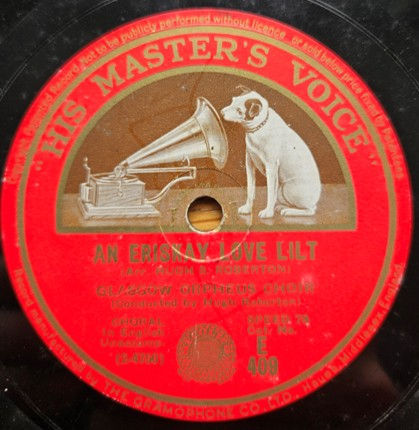
Though Glasgow was an industrial city, it held a deep connection to the Highlands and Islands. Many Highland families moved there for work, bringing Gaelic traditions and songs with them. Pieces like this Hebridean melody helped preserve those cultural roots in an urban setting.
Early recordings like this were made acoustically — singers gathered around a recording horn rather than microphones. Balance depended entirely on physical positioning, meaning choir members literally stepped forward or backward to control volume. It gives these recordings their distinctive, almost ghost-like atmosphere.
The Orpheus Choir represented civic pride as much as musical excellence. They showed that Glasgow was not only a city of shipyards, but also of refinement, artistry, and shared cultural heritage.
Let us now hear that timeless island melody as captured exactly a century ago — An Eriskay Love Lilt by the Glasgow Orpheus Choir.

Now we turn to Glasgow humour — because no portrait of the city would ever be complete without a good laugh.
This is I’m Aggie from Glasgow Toon, recorded in 1957 by the much-loved Scottish actress and comedian Molly Weir on the Parlophone label.

Molly Weir became famous for her sharp observational comedy and instantly recognisable Glasgow voice. She captured the everyday character of the city — the strong-willed women, neighbourly gossip, and affectionate self-mockery that defined tenement life.
The word “toon,” of course, simply means “town,” but in Glasgow it carries identity and pride. Comedy songs like this were hugely popular on radio and variety stages, where audiences delighted in hearing their own speech and experiences reflected back at them.
During the 1950s, recordings such as this helped preserve regional accents at a time when broadcasting often favoured more formal English tones. Molly Weir’s success showed that authenticity — and a good sense of humour — could win national audiences.
So prepare for a smile as Glasgow introduces herself properly. Here is Molly Weir with I’m Aggie from Glasgow Toon.

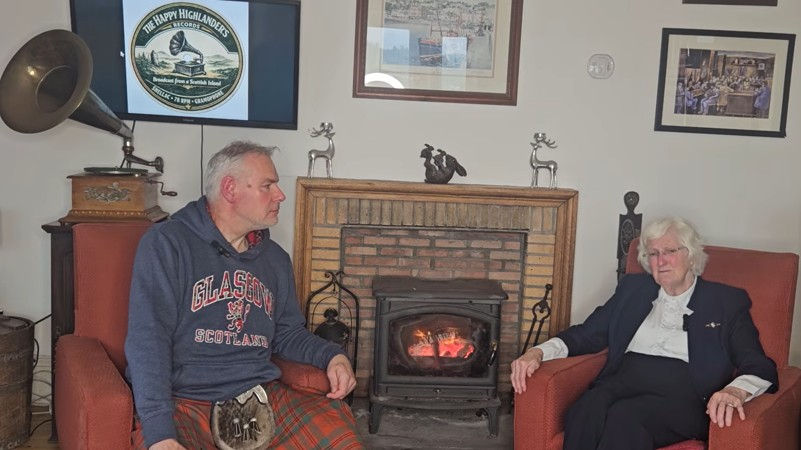
There is then the first part of an interview with my mum, Rona, born in Glasgow in 1940.
She discusses her memories of growing up in Glasgow, first with 1947 when a big snow fall (over 1m deep) gave her and her childhood friends a wonderful time sledging.
One highlight from the 1950s was in 1953 when sweets became unrationed - tasting sweets for the first time! And then a description of everyone seeking to buy televisions for the first time, to watch the Coronation of Queen Elizabeth in 1953.
My mum then goes on to describe the family shop - when a weekly order was put in at the start of the month and this was repeated each week for that month and then all paid for at the end of the month. My mother still remembers her Coop (shop) number: 19560.
At the age of six or seven, my mother was allowed to go to the shops on her own to get a "thruppence worth of chips". She explained that she as a child, had total freedom - including going as a group of children for a picnic by climbing over the fence at Glasgow Airport and sitting on the grass next to the airplanes!

Our next record brings together music hall tradition and river nostalgia.
Sailing Up the Clyde, recorded in May 1956 by entertainer Jimmy Logan on the Philips label, celebrates one of Scotland’s most beloved excursions — the Clyde steamer trip.
For generations, Glaswegians escaped the city’s smoke and industry by boarding paddle steamers bound for seaside resorts like Rothesay, Dunoon, and Millport. The journey itself became part of holiday culture — dancing on deck, tea rooms below, and brass bands playing as the ship moved past shipyards and open water.

Jimmy Logan was a major figure in Scottish theatre and variety entertainment, later becoming owner of Glasgow’s famous Metropole Theatre. His performances combined singing, comedy, and storytelling — perfectly suited to songs celebrating shared memories.
Interestingly, these steamer trips were sometimes called “doon the watter,” a phrase still fondly remembered today.
So let us climb aboard, hear the engines turning, and sail gently upriver with Jimmy Logan and Sailing Up the Clyde.

The second part of the interview with my mum, Rona, then begins with more memories of growing up in Glasgow. The first recollections are about transport and since her family did not have a car until about 1958 or 1959, travelling was done by tram car or bus, or for holidays, by train. She describes seeing the ruins of the the Clydebank Blitz of 1941 and seeing a ruined tenement building of apartments, with a toilet still hanging half way up the exposed wall (see also episode 4 "When the Bells Rang and the Flags Flew: VE Day 1945" for another interview with my mum, where she describes the Clydebank Blitz). She also describes being car sick on trips by bus to see her grandparents (no plastic bags in the 1950s, so her sickness had to be caught in newspapers!). Holidays by train to Rothesay, Gourock or Irvine (what was called "doon the water" - downstream further down the River Clyde). Holidays further afield were in Fraserburgh in the north east of Scotland.
Rona then describes her education journey from Primary School through to University. From playground games in Primary School to leaving secondary school in 1957 to go to University at the age of 17. She studied Micro-Biology at Glasgow University, staying at home (with no phone at all, not even a land-line!). On graduation in 1961, she moved to Aberdeen where she still lives.
The interview is rounded off with some fascinating stories about socialising - from trips to the pantomimes with Brownies; and Scottish country dancing with the Guides, with the local Boys Brigade. There was then socialising through the Youth Fellowship before going to University with lunch socialising in the University Women's Union, and on Saturday night to the men's Union for dances.
For our final record, we come to perhaps the most famous comic anthem ever associated with the city — I Belong to Glasgow.
This version, performed by the internationally celebrated entertainer Danny Kaye, dates from around the early 1950s and appears here on a white label pressing — always intriguing for collectors, as such records were often test pressings or special promotional issues.
The song itself dates back to music hall performer Will Fyffe, whose comic storytelling turned it into an enduring symbol of Glasgow humour. Despite its playful reputation as a drinking song, it’s really about wit, exaggeration, and the cheerful resilience Glaswegians are known for.

Danny Kaye’s involvement shows how far Glasgow’s cultural identity travelled. An American star embracing a Scottish comic song demonstrates the global appeal of the city’s humour and character.
By the mid-twentieth century, Glasgow songs were no longer purely local — they belonged to the wider world, just as many Glaswegians themselves had emigrated and carried their culture abroad.
And so, to close today’s journey through shellac and song, here is Danny Kaye with I Belong to Glasgow.

And as the last notes fade and the gramophone slows, we leave Glasgow - a city of river and resilience, laughter and lyricism.
Today’s five records have carried us along the Clyde itself: from proud song and island melody, to music hall laughter and steamer-day memories. We have also heard from my mother with fascinating stories of her time growing up in Glasgow. Together they remind us that a city is not only built of stone, steel, or shipyards - but of voices. Voices that sing when times are good, and sing even louder when times are hard.
Glasgow has always possessed that rare gift: the ability to meet life with humour, warmth, and a stubborn kind of joy. Its people turned work into song, distance into belonging, and ordinary days into stories worth telling again and again - preserved here in spinning shellac grooves. You’ve been listening to The Happy Highlander's Records, where every groove tells a story.
This edition was recorded on an island off the West coast of Scot where my collection of some 160,000 old shellac records is lovingly kept – to preserve, record and share these sounds from the past at 78rpm. You can listen to more episodes via my website TheHappyHighlandersRecords.com and you can also listen to recordings of each individual record via my YouTube Channel Scottish Island Records.
There’s a saying often linked with the spirit of the city: “Happiness is not something ready-made - it comes from the way we share our lives with others.”
And perhaps nowhere has that truth sounded more clearly than in Glasgow’s music, its laughter, and its generous heart.
So wherever you may be listening today, may these old records remind you that happiness can be as simple as a familiar tune, a remembered voice, and a moment shared across time.
You’ve been listening to The Happy Highlander’s Records. Until the next record turns — keep smiling, keep listening… and keep a little music in your life.

Comments