


THE HAPPY HIGHLANDER’S RECORDS EPISODE 9 : Votes, Voices & Shellac — The Suffragette Special
Updated: May 1
You can watch the video episode here
(full of bonus images and slides with information in text form):
Or you can listen to the Audio Podcast here:
THE HAPPY HIGHLANDER’S RECORDS
EPISODE 9
Votes, Voices & Shellac — The Suffragette Special

Fit like a’body. I hope you are all hale and hearty and most importantly, happy. So hello and welcome, friends, to The Happy Highlander’s Records — the programme where we wind back time, lower the needle, and let history sing for itself.
This episode is a very special one indeed. We’re stepping into the world of the suffragettes - a movement of courage, controversy, determination, and above all, voices that refused to be silenced. But rather than reading from textbooks or reciting timelines, we’re going to hear history the way people heard it more than a century ago… through original 78-rpm shellac gramophone records.
These fragile discs - heavy, breakable, and wonderfully alive with surface hiss - are time machines. They carry not only music and speech, but atmosphere. Every pop, every crackle, every faint rumble is the sound of the past reaching out to us.
Between roughly 1909 and 1915, as campaigns for women’s voting rights intensified in Britain and America, record companies captured speeches, marches, comic sketches, and patriotic songs reflecting the debate. Some recordings supported suffrage. Some mocked it. All of them, in their own way, document a society wrestling with change. In this episode I’ll be playing five sides from original records of the era.
Before each one, I’ll tell you a little about what you’re about to hear — who made it, why it mattered, and a few curious titbits that might surprise you. Think of it as a fireside chat with history… and alongside our fire is a spinning turntable. So settle in, imagine the glow of gaslight, and let us begin our journey into the soundscape of the suffragette age.
Our first record takes us to July 15th, 1914 - barely weeks before the First World War would change everything. This is Fall in Line, a Suffrage March, performed by the Victor Military Band and issued on the Victor label. The playing time is under three minutes, but it captures the spirit of a movement that had been marching - quite literally - for decades.

Marches were essential to suffrage demonstrations. Organised processions filled city streets with banners, sashes, and disciplined ranks of women determined to show that they were not a fringe cause but a public force. Music like this helped keep step, boosted morale, and projected confidence. A good march tune was propaganda you could hum.
Military bands were popular recording artists at the time because early recording technology favoured loud, bold instruments. Brass and drums cut through the acoustic horn beautifully, while softer instruments often disappeared. So even though this is a political march, it’s played with all the pomp and polish of a parade ground. There’s also something deliciously ironic about suffragettes - often accused by critics of being “unfeminine” or “militant” - being accompanied by music in the grand martial tradition. Whether intentional or not, it sends a message: these women meant business.
Listen carefully and you may notice the brisk tempo and bright tone - not mournful, not pleading, but confident and forward-moving. That was exactly the image the movement wanted to project. Let’s place the needle now and hear the sound of determination in step.

On the reverse side of that same disc we find something entirely different: Mr Dooley’s Address to the Suffragists, performed by Steve Porter and released in January 1915.

Mr Dooley was a popular fictional character known for humorous Irish-accented commentary on politics and society. Audiences loved comic monologues like this — they were the stand-up routines of their day. Record buyers didn’t just want music; they wanted entertainment they could replay in their parlours for guests.
This piece reflects how suffrage was not only a political issue but also a subject of satire. Comedians poked fun at campaigners, at politicians, and at the arguments flying back and forth. Humor was a way for society to process change — sometimes supportive, sometimes skeptical, often both at once.
This recording presents an Irish-American's pro-women's suffrage address. In it the performer promotes a constitutional amendment giving women in all states of Amercia the right to vote. There is also a declaration that the suffrage issue will be a plank in every 1916 election
Steve Porter, the performer, was famous for character voices and comic timing. Early recording artists had to exaggerate their speech and delivery because there were no microphones or editing. Everything was performed live into a recording horn, usually in a single take. If someone coughed or stumbled, the whole thing had to be redone.
So what you’re about to hear is essentially a one-shot performance from over a century ago — preserved exactly as it happened in the studio.
Let’s turn the disc over and hear Mr Dooley have his say.

Our third selection is delightfully unexpected: The Suffragette Polka, also known as La Femministe, played by the Imperial Guards Band on the Phoenix label, dating from around 1913 and running at just under two and a half minutes.

A polka might not be the first musical style you associate with political activism, but dance music was hugely popular in the early twentieth century. By attaching a fashionable dance title to a topical theme, publishers could ride the wave of public interest. In other words — if suffrage was in the headlines, it might as well be on the dance floor too.
Titles like this didn’t always mean the music itself was political. Sometimes the name alone was enough to attract buyers. It was the Edwardian equivalent of a marketing hook: take a trend everyone’s talking about and turn it into a tune.
The Phoenix label, like many smaller companies of the era, produced affordable records for the mass market. Not everyone could afford premium brands, so budget labels helped spread both music and ideas to a wider audience.
So as you listen, imagine a living room cleared of furniture, couples stepping lively across the carpet, and conversation buzzing about the latest news — perhaps even about votes for women.
Here is The Suffragette Polka.
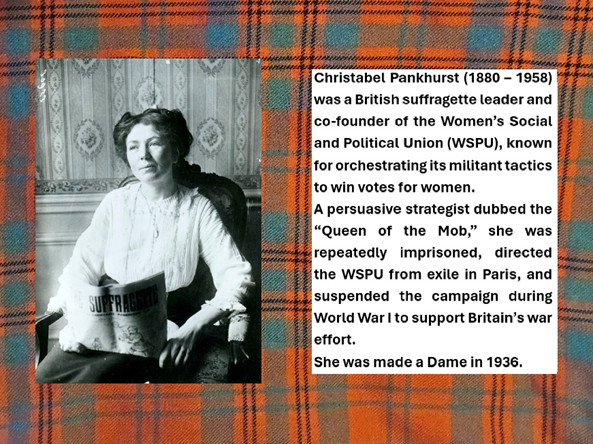
Now we come to something truly historic: a spoken recording titled Suffrage for Women, delivered by Christabel Pankhurst and recorded in 1909 for the His Master’s Voice label. This disc runs to three and a half minutes — quite long for an early record, which is why it is on a larger disc – 12 inches instead of the more common 10 inch discs.

Unlike music, speeches on record were still something of a novelty at the time. The idea that you could hear a famous political figure’s actual voice in your own home was astonishing. For many listeners, this might have been the only chance they would ever have to hear such a person speak.
Recordings like this were powerful tools. They allowed campaigners to reach supporters far beyond the halls and rallies where speeches were delivered. In a sense, this was early broadcast media — activism pressed into grooves.
When listening, notice the speaking style. Early twentieth-century oratory tends to sound more formal and emphatic than modern speech. Public speakers trained their voices to project across large halls without amplification, and that dramatic delivery carried over into recordings.
What you’re about to hear is not an actor, not a reconstruction, but a real voice from 1909 addressing listeners directly across time.
Let us listen.
Our final record of this episode brings us into wartime. Women of Britain, performed by George Baker with the Mayfair Orchestra, was recorded on November 30th, 1915.

By this point the First World War was underway, and the role of women in society was rapidly changing. With millions of men at the front, women stepped into jobs, industries, and responsibilities previously denied to them. Public perception began to shift. The image of women as capable, patriotic contributors strengthened arguments that they deserved full citizenship — including the vote.
Songs like this often carried patriotic themes, encouraging unity and morale on the home front. Music publishers understood that sentiment sold records, and patriotic songs were especially popular during wartime.
It’s worth remembering that records themselves were part of wartime life. Families gathered around gramophones for news, comfort, and entertainment, much as later generations would gather around radios.
So as this final disc plays, imagine a household in 1915 listening closely, perhaps with a son, husband, or brother fighting overseas — and feeling that the world, and women’s place in it, was changing forever. Here is Women of Britain.

And that brings us to the end of this episode’s journey through the grooves of history. Thank you for joining me on The Happy Highlander’s Records. This episode featured five record sides, five glimpses into a movement that reshaped society, and five reminders that sound can preserve not just music, but moments.
This edition was recorded on an island off the West coast of Scotland where my collection of some 160,000 old shellac records is lovingly kept – to preserve, record and share these sounds from the past at 78rpm.
You can listen to recordings of each individual record via my website HappyHighlandersRecords.com and also via my YouTube Channel Scottish Islands Records.
So as we close this special episode, perhaps the lesson those old grooves still carry is this — change belongs to those bold enough to be heard. After all, Christabel Pankhurst’s mother, Emmeline Pankhurst who was also an activist, told us: ‘You have to make more noise than anybody else.’
Until next time, keep your gramophones wound… and your curiosity spinning.
Comments