


THE HAPPY HIGHLANDER’S RECORDS EPISODE 1 : World Laughter Day Special – “Laughing on Shellac” - Part 1.
Updated: May 1
You can watch the video episode here
(full of bonus images and slides with information in text form):
Or you can listen to the Audio Podcast here:
THE HAPPY HIGHLANDER’S RECORDS
EPISODE 1
World Laughter Day Special – “Laughing on Shellac”

Fit like a’body. I hope you are all hale and hearty and most importantly, happy. So hello and welcome, friends, to The Happy Highlander’s Records — the programme where we spin the stories and sounds of the past from the wonderful world of old shellac gramophone records.
This is my first broadcast episode on this channel and that in itself makes this a special episode, however today’s broadcast also a special occasion because we’re celebrating World Laughter Day, which this year falls on the 3rd of May 2026. And to make it even more special, I am doing two broadcasts on Laughter – this episode 1 and then episode 2 where we will carry on the laughter and happiness.
World Laughter Day was first organised in 1998 by Dr. Madan Kataria, the founder of the Laughter Yoga movement. His idea was simple but powerful: laughter brings people together, lifts the mood, and reminds us not to take life quite so seriously.
Now, if you think about it, laughter has been part of recorded entertainment almost from the very beginning. When early recording artists realised that people loved novelty, comedy, and a good chuckle, they began recording songs and sketches that included laughter itself — sometimes genuine, sometimes completely theatrical!
So today, we’re going to celebrate laughter the way people did a hundred years ago. On the turntable I have five sides of old 78-rpm shellac records, each with a laughing theme. These recordings span the early decades of the twentieth century, when novelty records and comic songs were hugely popular in music halls and homes alike. You’ll hear laughing policemen, laughing singers, laughing drummers — and even a Scottish comic legend trying to survive being tickled! So wind up the gramophone, settle in comfortably, and let’s begin our World Laughter Day edition of The Happy Highlander’s Records.
Our first record takes us back over a century and is “The Laughing Policeman” performed by Charles Jolly, recorded in June 1922 on the Regal Records label.
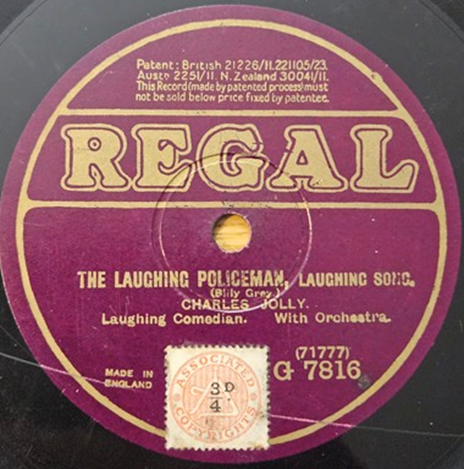
The Regal Records label was owned by the Columbia Graphophone Company and was aimed at the budget end of the market. That meant records like this were affordable for ordinary households, helping comic songs spread widely.
Now The Laughing Policeman is one of the most famous laughing novelty records ever made. Charles Jolly was a music hall entertainer and comedian who specialised in comic monologues and songs. But this record is something quite unique — because the laughter becomes part of the performance itself.
The idea of a “laughing song” actually goes back even earlier than this recording. There was a very popular piece in the 1890s called The Laughing Song performed by George W. Johnson, one of the earliest African-American recording stars. Audiences loved the infectious laughter so much that the idea spread across the recording world.
By the 1920s, the concept of the original “The Laughing Song” had evolved into this character: the cheerful policeman who simply can’t stop laughing. What makes Jolly’s version so memorable is the way the laughter builds and builds until it becomes almost ridiculous. It’s theatrical, exaggerated, and absolutely typical of the British music hall tradition where performers relied heavily on personality and audience interaction. And of course, when people first heard this at home on their wind-up gramophones, it must have been wonderfully contagious — laughter coming right out of the horn of the machine.
So let’s step back to 1922, and hear the cheerful chuckles of Charles Jolly with “The Laughing Policeman.”

Our second record takes us even further back — all the way to September 23rd, 1903.
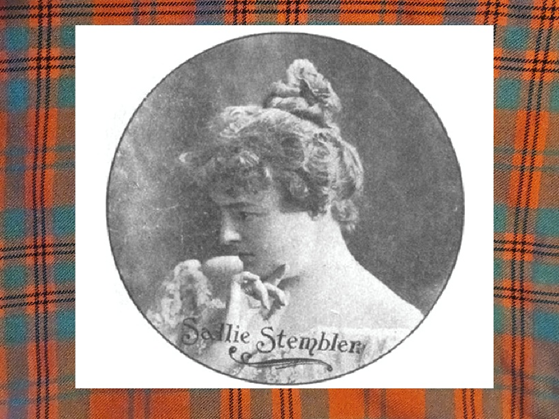
This was when the “Laughing Song” performed by Sallie Stembler was recorded and issued on the famous Victor Talking Machine Company label.

Now 1903 is very early in the history of commercial recording. At that time records were still a novelty in many homes, and performers often recorded short comic pieces that would grab attention quickly.
Miss Sallie Stembler was one of the many vaudeville and variety performers who recorded for Victor in the early 1900s.
Records in those days were usually made acoustically — meaning the singer stood in front of a large recording horn, and the sound waves directly moved a stylus cutting into a wax disc.
No microphones, no electricity, and definitely no editing!
Because of that, performers had to be energetic and very expressive. Laughing songs worked particularly well, because laughter cuts through the mechanical recording process quite clearly.
These records were often played at social gatherings, and you can imagine a group of people around the gramophone smiling and laughing along with the performer.
In many ways, these early novelty records are the ancestors of today’s comedy recordings and even viral audio clips — short, catchy, and designed to make people smile.
So let’s travel back to 1903 and hear the cheerful sounds of Miss Sallie Stembler with her “Laughing Song.”
Next we have something rather intriguing: The “Unique” Scala Laughing Record, issued on the Scala Ideal Record label around 1922. Now this record is a bit of a mystery — and collectors of old shellac records love a mystery! Unlike many records of the time, this one doesn’t clearly credit a performer. Instead, it’s presented almost as a novelty sound effect — a whole chorus of laughter captured on record.

Records like this were actually the ancestors of later sound-effects records used in radio and theatre. By the 1930s and 40s, entire libraries of sound recordings existed for laughter, crowds, trains, and thunderstorms. So this little record represents an early experiment in recording sound purely for fun rather than music.
The Scala Ideal label was part of the budget record market in Britain during the early 1920s. These companies often produced novelty records, sound effects, and comic sketches that were affordable and widely distributed.
Sometimes these recordings were performed by studio entertainers whose names weren’t even listed, which adds to the intrigue for collectors today. The description “Unique” in the title was likely a bit of marketing flair — suggesting that this was something unusual you could play for friends and family as a party piece.
Imagine visiting someone’s home in the 1920s, and instead of a song, they play a record that is simply an outbreak of laughter coming from the gramophone! It’s a reminder that early records weren’t just about music — they were about entertainment in every form, from speeches and comedy sketches to train sounds and animal noises. So here is the wonderfully curious “Unique” Scala Laughing Record, a little slice of novelty recording from the early 1920s.
Now for something proudly Scottish.
Our fourth record is “Stop Yer Tickling Jock”, recorded in August 1930 by the legendary Sir Harry Lauder, and released on the Zonophone Records label.

Sir Harry Lauder was one of Scotland’s greatest entertainers and one of the biggest stars of the music hall era. With his trademark kilt, walking stick, and broad Scottish humour, he became internationally famous in the early twentieth century. Lauder wasn’t just popular in Britain — he toured widely in the United States, Australia, and beyond. By the time Harry Lauder recorded this in 1930, he had already been an international star for decades. In the 1910s he was reportedly the highest-paid entertainer in the world.
His songs often celebrated Scottish life, characters, and humour, and audiences loved the warmth and personality he brought to the stage.
“Stop Yer Tickling Jock” is a perfect example of that playful humour — full of laughter and comic storytelling. Records like this captured a little of the atmosphere of the music hall, where audiences would laugh, clap, and sing along. By 1930, the recording technology had improved considerably, but the spirit of the old music hall was still very much alive in performers like Harry Lauder.
So in honour of Scotland — and perhaps with a nod to the Highlands — here is the great Sir Harry Lauder with “Stop Yer Tickling Jock.”

For our final record today, we return to 1922 with “Laughing Jazz Drummer” performed by Charles Penrose, issued on the Edison Bell Winner label.

Charles Penrose was another prolific comic performer and recording artist of the early twentieth century – and in fact one of his pseudonyms was Charles Jolly – the artist’s name against The Laughing Policeman record we heard first! He specialised in novelty songs, humorous sketches, and character pieces — exactly the sort of entertainment that worked beautifully on 78-rpm records.
This recording captures something very characteristic of the Jazz Age, when jazz rhythms and comic novelty records were both extremely fashionable.
The idea of a “laughing drummer” mixes musical performance with comedy — the performer laughing while keeping up the rhythm, creating a piece that is as much theatre as it is music.
Budget labels like Edison Bell Winner made these sorts of recordings widely available to the public. For many families, records like this were part of their home entertainment long before radio became common.
And that’s something rather magical about these old shellac discs: they still carry the sound of people laughing more than a century ago.
So to finish our first episode of our 2026 World Laughter Day programme, here is Charles Penrose with the wonderfully lively “Laughing Jazz Drummer.”

And that brings us to the end of this first ever edition of The Happy Highlander’s Record broadcast and I cant think of anything more fitting for the first episode than these old but beautiful recordings for World Laughter Day – laughter and happiness combined in magical old sounds!
In this first episode we’ve travelled back through more than a century of recorded sound, listening to laughter captured in the grooves of old 78-rpm shellac records — from the early days of acoustic recording right through to the lively novelty recordings of the 1920s and 30s.
We heard the cheerful chuckles of Charles Jolly, the early recording humour of Sallie Stembler, the curious mystery of the Scala Laughing Record, the unmistakable Scottish wit of Harry Lauder, and finally the rhythmic comedy of Charles Penrose.
It’s quite wonderful to think that when these records were first played — perhaps in a parlour with a wind-up gramophone — families and friends would have gathered around, listening, smiling, and very likely laughing along. And that’s exactly what World Laughter Day is all about.
The day was created by Dr. Kataria to remind us that laughter is universal. No matter where we come from, a good laugh brings people together – and indeed that is the aim of this Happy Highlanders Records channel, bringing people together through old shellac 78rpm records.
These old records show that people were sharing laughter long before radio, television, or the internet — all it took was a wind-up gramophone, a spinning disc, and a performer with a good sense of humour.
So I hope these cheerful recordings have brought a smile to your face today and if you enjoyed this – then please watch and listen to episode 2 which continues the laughter. This edition was recorded on an island off the West coast of Scotland where my collection of some 160,000 old shellac records is lovingly kept – to preserve, record and share these sounds from the past at 78rpm. You can listen to more recordings via my website TheHappyHighlandersRecords.com and also via my YouTube Channel Scottish Islands Records.
Thank you very much for joining me here on The Happy Highlander’s Records. If you enjoy exploring the sounds and stories of old gramophone records, do join me again for another journey into the musical past. Until next time, keep the gramophone turning… …and keep laughing.
Comments